Four Problems.
Two Layers.
One Solution.

Every fine-pitch LED display shares the same four flaws. NovaVista doesn't hide them — it eliminates them at the optical level. Here's how.

Have You Encountered
These?

If you work with professional LED displays, you already know these. You've probably learned to work around them. You shouldn't have to.

Screen Door Effect

The dark grid between pixels. Your brain fills it in at a distance — but up close, or on camera, it's always there.

Root cause: fill factor < 40%

Moire Patterns

Wavy interference fringes when a camera captures the screen. The spatial frequency of the pixel grid conflicts with the camera sensor.

Kills live production

Washed-Out Blacks

Dark scenes look gray because the display surface reflects ambient light back at the viewer. "Black" is reflected light, not darkness.

Root cause: reflectance > 8%

Glare & Reflection

Studio lights, lobby windows, showroom spots — they all bounce off the screen. The image fights the room.

Unusable in bright spaces
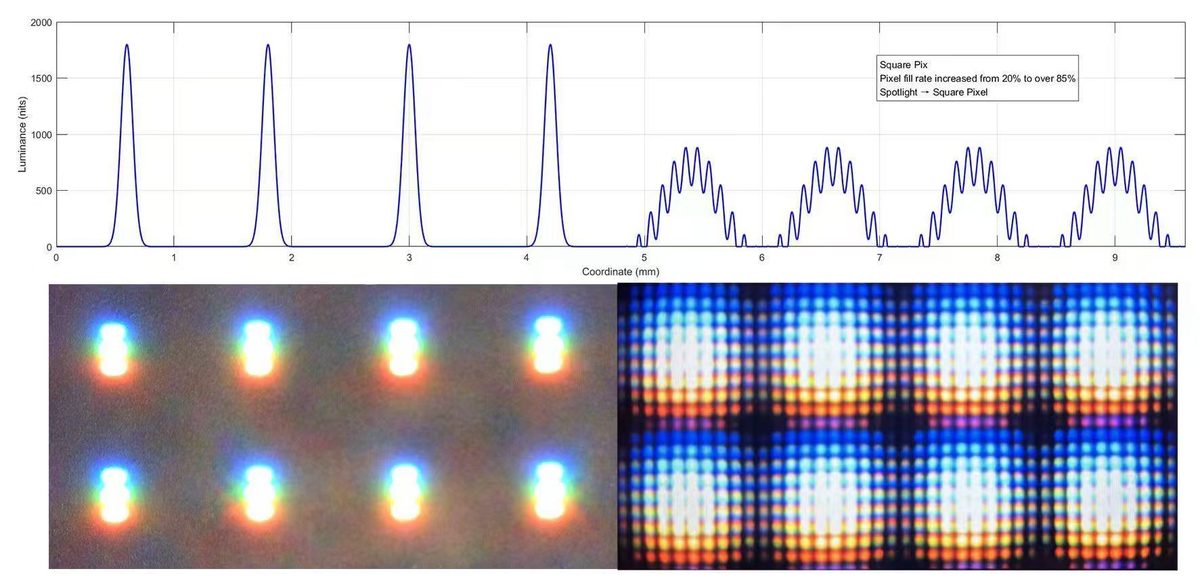
Traditional LED vs NovaVista — pixel grid comparison

Left: Standard LED fill factor ~40% — visible grid, screen door effect. Right: NovaVista 85%+ fill factor — continuous surface.
The Numbers That Matter.

After NovaVista's optical reconstruction, these are the measured results — not marketing claims, not software tricks.

110%
NTSC Color Gamut
Wider than most OLED panels
85%+
Pixel Fill Factor
Up from 30-40% — grid eliminated
~2%
Surface Reflectance
Down from 8-12% — black stays black
8000:1
Contrast Ratio
Holds at low brightness

Two Optical Layers.
One Continuous Surface.

Each layer solves specific problems. Together, they eliminate all four.

1

Dual-Axis Grating

Solves: Screen Door Effect + Moire Patterns

Phase + amplitude modulation reshapes scattered point light into uniform plane light. Fill factor: 85%+.

2

AR/AG Surface

Solves: Washed-Out Blacks + Glare & Reflection

Ultra-low reflectance top layer (~2%). Glare eliminated. Black stays black — on or off.

The Optical Sculptor.

Phase modulation and amplitude modulation, working as one.

The problem: LED pixels are point sources. They emit light in a divergent spray. Between pixels, there's darkness — circuitry, gaps, dead space. Standard fill factor is 30-40%. Your brain interpolates the gaps at a distance, but cameras don't. The result is the screen door effect — and when the camera sensor's spatial frequency conflicts with the pixel grid, moire.

The solution: A dual-axis grating placed in front of each pixel. Think of it as a precision optical structure that does two things simultaneously:

Reshape the Beam

Phase Modulation

The grating reads the chaotic, divergent spray of photons and orchestrates them — delaying some, accelerating others — until they all march in the same direction. A scattered spotlight becomes a uniform, collimated beam. Point light becomes plane light.

Filter the Spectrum

Amplitude Modulation

At the same time, the grating acts as a spectral gatekeeper. Only high-amplitude, pure-wavelength light passes through. Stray light, off-angle emissions, and unwanted spectral noise are redirected or absorbed. The light that reaches your eye has been purified.

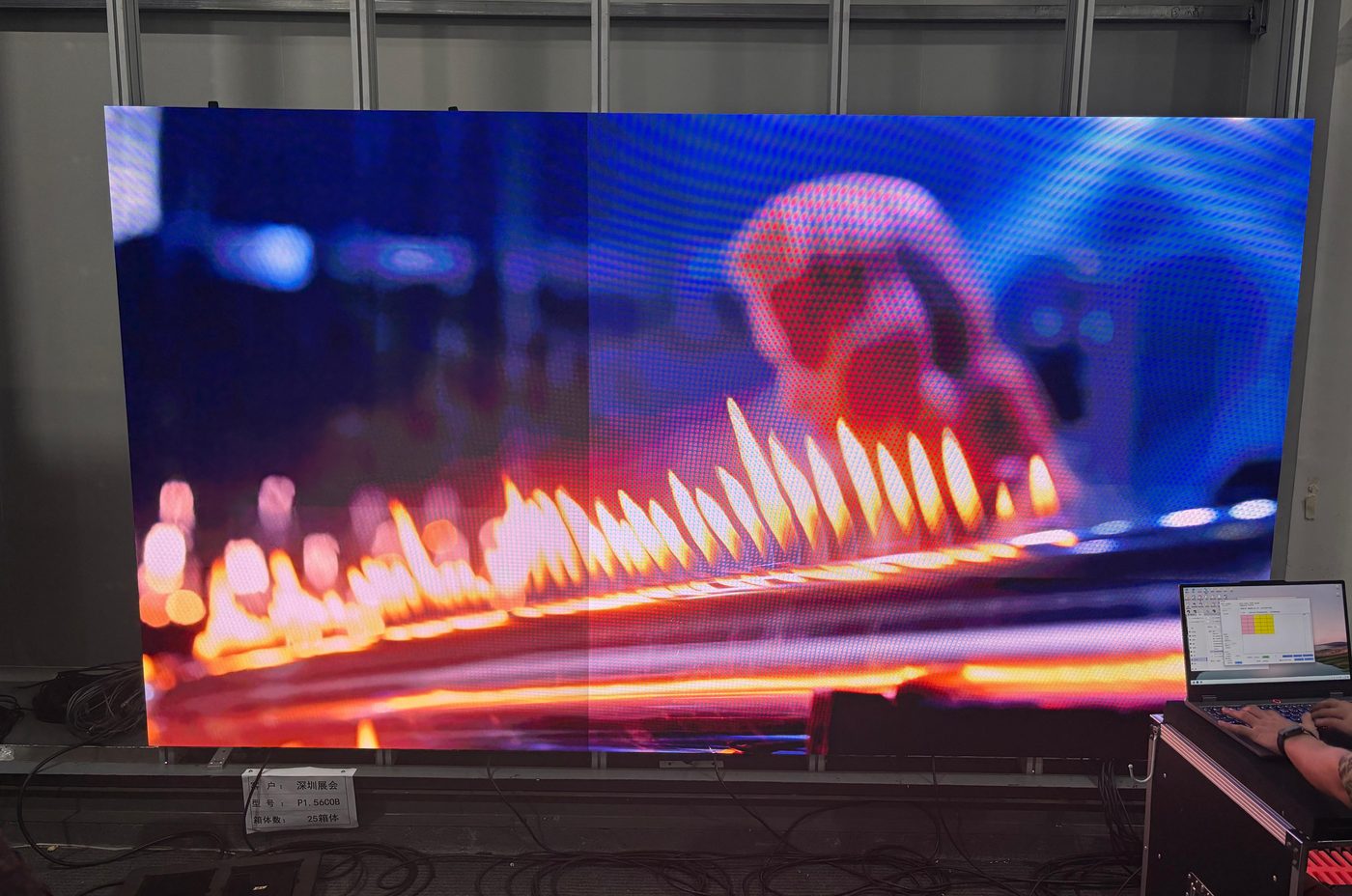
The result: Pixel fill factor jumps from ~40% to over 85%. What was once a grid of isolated dots becomes a continuous, luminous plane. The screen door effect vanishes. Moire becomes physically impossible — because there's no grid for the camera sensor to interfere with.

Dual-axis optical grating microstructure visualization

Dual-axis grating: scattered point light (left) reshaped into uniform parallel beams (right).

Point light reshaped to fill the cell — 85%+ fill factor

Black Performance Technology.

When the screen is off, it should look like nothing.

The problem: Most LED displays have a high-reflectance surface (8-12%). Under room lighting, they look gray. Washed out. Foggy. The black you see isn't black — it's reflected ambient light mixing with the display's attempt at darkness. Studio lights, lobby windows, showroom spots — they all bounce back at the viewer.

The solution: NovaVista's AR/AG (Anti-Reflective / Anti-Glare) surface layer:

  • Ultra-low reflectance (~2%) — Light from the room bounces away instead of back at you. The surface reads as deep black, not milky gray — whether the display is on or off.
  • Controlled gloss (~40 GU) — The exact visual texture of a premium OLED panel. Not matte enough to diffuse the image. Not glossy enough to create hotspots.

The result: Contrast ratio of 8000:1 — holding even at low brightness where most panels collapse to 128 gray levels. The display reads as a dark, polished panel when off, a vivid canvas when on. Not a screen. A surface.

NovaVista Extreme Black Series LED display in real-world operation

The Extreme Black surface delivers vibrant, accurate color in real-world environments — even under direct ambient light.

Designed for the Eyes,
Not Just the Eyes.

Three ways NovaVista protects your viewers — without them ever noticing.

01

Blue Light Filtration

Certain wavelengths of blue light (415-455 nm) contribute to retinal oxidative stress. NovaVista filters these bands optically — at the structural level. Colors remain accurate. Your eyes just don't work as hard.

02

Moire Suppression

By expanding each pixel from a point to a filled square, NovaVista changes the spatial frequency relationship between the display and the camera sensor. The probability of moire formation drops to negligible levels.

03

Optimal Viewing Distance

NovaVista's continuous emissive surface means the eye perceives a coherent image at shorter distances — equivalent to a finer physical pitch without the manufacturing cost.

04

VICO ≤ 1.8

Rated "Excellent" on the Visual ergonomics index. Operators can maintain focus across 12-hour shifts without the cumulative eye fatigue of traditional LED walls.

Same Destination.
Different Path.

Sony's Crystal LED and BOE's premium panels proved that continuous emissive surfaces are the future of professional display. NovaVista arrives at the same destination — through a different optical path.

Different Path. Same Destination.

Sony uses micro-LEDs to shrink the gaps between pixels. NovaVista uses optical reconstruction to fill the gaps. Same continuous surface. Same invisible pixels. No micro-LED cost premium.

OLED-level image quality LED durability & brightness No micro-LED cost premium

This Is Physics, Not Marketing.

We publish our optical measurement methodology. We welcome third-party verification. If you're an engineer, an integrator, or a skeptic — let's talk.

Request Technical Documentation Schedule a Lab Visit